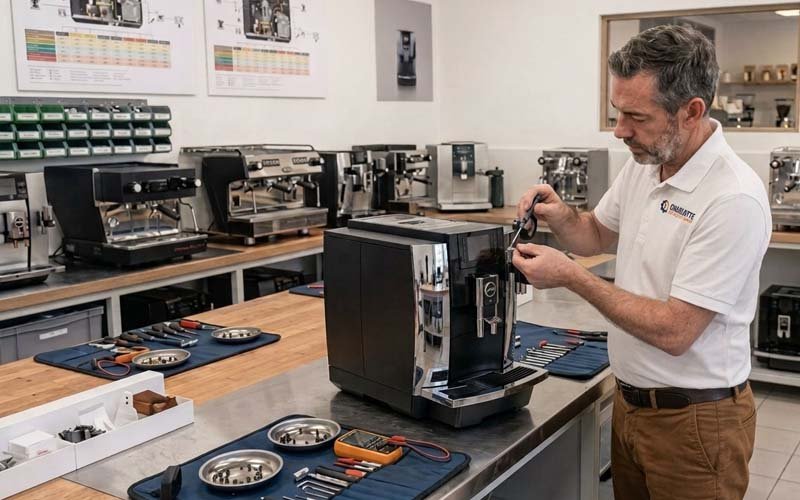

Espresso Machine Repair in Charlotte: 5 Quick Fixes
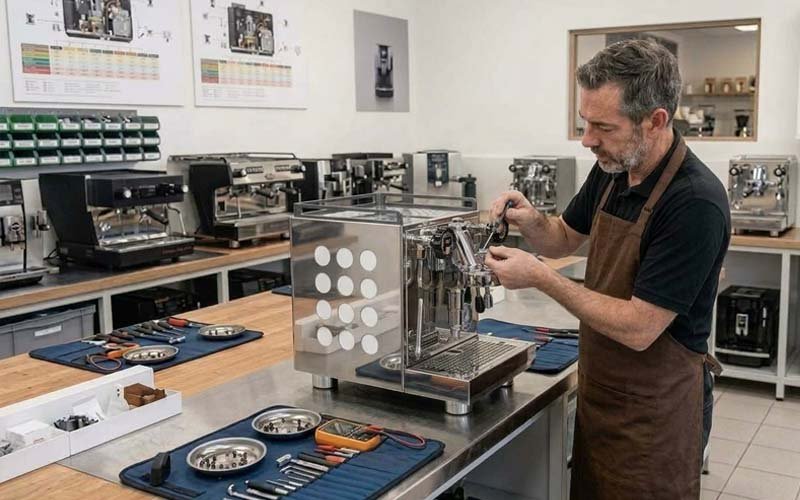
Rocket Espresso machines are masterpieces of Milanese engineering. Wrapped in heavy-gauge 304 stainless steel and anchored by the legendary E61 chrome-plated brass group head, these machines are built to last a lifetime. However, because they operate under immense thermal expansion, high atmospheric pressure, and constant exposure to water minerals, internal wear is inevitable.
When a Rocket machine begins to struggle, it doesn’t just stop brewing. It sends distinct mechanical warnings—hissing noises, dripping group heads, fluctuating boiler pressures, and erratic temperature swings—that require professional technical diagnostic benches to resolve before catastrophic damage occurs.
Unlike super-automatic systems, Rocket machines span various internal architectures, from classic heat exchangers to dual-boiler profiling giants. Understanding your specific model’s footprint is essential for proper diagnostic testing.
The Appartamento is the iconic, compact cornerstone of Rocket’s domestic line, immediately recognizable by its circular side-panel cutouts. It uses a 1.8-liter copper boiler with a heat-exchanger (HX) design, allowing you to brew and steam simultaneously. The newer Appartamento TCA introduces electronic temperature control (an internal PID evolution). Because space is tight inside this compact chassis, internal components like the pressurestat, vacuum breaker valve, and expansion valve face extreme thermal saturation, making them the most frequent items on our local repair bench.
Available in the sleek, straight-paneled Mozzafiato body style or the classic, angular Giotto silhouette, the Cronometro series steps up home brewing with integrated digital shot timers and PID temperature controllers.
On our workbench, these models are frequently serviced for PID control board degradation and rotary pump bypass valve adjustments to correct erratic brew pressure.
The R Cinquantotto is a dual-boiler powerhouse engineered for elite home baristas. It separates the brewing architecture from the steam architecture with a 0.58-liter brew boiler and a 1.8-liter steam boiler, managed by an external touchscreen PID communication pod. Because of the dual-boiler design, the electrical current draw and hydraulic complexity double. Common bench repairs include replacing calcified immersion heating elements, clearing scaled-up commercial solenoids, and rebuilding the rotary pump assembly.
Representing the absolute pinnacle of Rocket’s residential engineering, the R Nine One brings commercial saturated group-head technology and fully manual digital pressure profiling into the kitchen. It features a massive multi-boiler system and a digital paddle mechanism to vary pump pressure mid-shot. This machine is an incredibly sophisticated computer-hydraulic hybrid. If electronic sensors fail or internal Teflon water paths experience mineral blockages, it requires specialized, white-glove diagnostics to prevent damage to the proprietary saturated group head.
When a Rocket machine acts up, our technicians look for specific systemic failures. The most common mechanical issues encountered in our workshop include:
If you hear a constant, faint hissing sound or see a steady plume of steam rising through the top cup-warming tray, your machine has a failing vacuum breaker valve or a stuck pressurestat. The vacuum breaker is designed to seal shut once the boiler builds steam pressure. Over time, hard water scale coats the internal Teflon seal, preventing it from seating fully. If your steam pressure gauge spikes past 1.5 bar and trips your safety relief valve, the mechanical Mater or Sirai pressurestat has likely arc-welded its contacts together, sticking in the “always on” position and overheating the boiler.
The E61 group head is an absolute workhorse, but it relies on mechanical brass cams, pins, and springs to seal off high-pressure water paths. If your machine drips water continuously into the drip tray while idling, or leaks out of the bottom discharge exhaust when brewing, the internal pre-infusion or exhaust valves are worn out. Over years of backflushing and thermal cycling, the internal brass components strip away their factory lubricants and distort, allowing pressurized water to tunnel straight through the seals.
If your pump runs loudly but the brew pressure gauge fails to reach 9 bar (or drops down to 3-4 bar during a shot), your hydraulic delivery system is failing. On vibration pump models (Appartamento, Cronometro V), the internal plastic piston seats degrade, leading to complete pressure failure. On rotary pump models (Cronometro R, R58), the internal stainless steel bypass valve can seize up due to scale buildup, locking the pump flow or causing it to cavitate.
To maximize the life of your machine, keep your shots tasting crisp, and prevent costly bench fees, you must follow a strict, multi-tiered maintenance routine.
Attempting to self-repair a premium Rocket espresso machine without specialized tools is highly risky. Copper lines bend easily, plumbing threads are often specialized British Standard Pipe (BSP), and high-voltage wiring blocks sit right next to pressurized water sources.
At Charlotte Espresso Repair, we take the stress completely off your shoulders. We offer a comprehensive Residential Repair Package that acts as a flat-rate labor fee (plus parts) to completely open your machine, run electronic diagnostics, clear mineral blockages, and rebuild your E61 group head.
Charlotte Espresso Repair provides secure pickup and delivery services across the greater Charlotte metro area—including Uptown, Myers Park, Dilworth, Ballantyne, and Lake Norman. Machines are securely serviced at our technical workshop located at 3609 Scot Futrell Drive, Charlotte NC 28208. For maintenance requests or repairs, contact us today at (980) 322-2157 or via email at info@charlotteespressorepair.com to schedule your premium pickup.